
Showing posts with label Communications and Sustainability. Show all posts
Showing posts with label Communications and Sustainability. Show all posts
Tuesday, 23 April 2013
The New Communications
A few years back my company was accused by a deeply misguided business journalist as not operating in the 'real economy'. Our focus on social goals, environmental issues and arts and culture clearly got him riled. He saw the impending age of austerity and public sector cuts as a signal that an agency like ours would be certain to fail.
The debt-fuelled, hyper-consumption based 'real economy' was about to falter, fold his magazine and put him out of a job, but regardless of his frame of reference it was clear that he didn't 'get' the idea that there was a different world of communications out there.
So it's time to establish more clearly the new communications.
What's it about? It's the critical revelation that you can sell great ideas and urgent issues of our time just as effectively and with as much flair as you can sell fast moving consumer goods. The campaigns and communications that emerge from the new communications are progressive, honest and effective. They can be energy campaigns that save money on bills, they can be recruitment campaigns for volunteers, carers or civic champions, they can raise money, they can get you off the sofa and out into a nature reserve; the new communications may even make you feel differently about the town, city or village where you live.
It's time to explode the idea that creative communications, by which I mean everything from advertising to direct marketing, media relations, social media campaigns and even the odd flash mob, is purely about selling stuff that we don’t really need.
The conventional ‘Mad Men’ world of consumer marketing is just one aspect of human communications. What other kinds of communications do we messy but wonderful humans indulge in?
There’s gossip, chatter with friends or colleagues and keeping up with family or loved ones, increasingly a strand of communications that is served through social media channels like Facebook or Twitter. There are more formal channels too. There’s public information - what time does the library open? How can I learn to swim? What day will my wheelie bin be emptied? After that there's social marketing. Much of this is health related (get fit, stop smoking, drink less) but it can also cover social calls to action, such as fostering a child, or changes in environmental behaviour.
Local communities communicate in their own distinctive way, too. Engagement at the community level is often overlooked as a critical part of communications. From the photocopied newsletter to online forums, street stalls or a notice pinned to a church door, local neighbourhoods can energise around an issue and then start to communicate.
There are political campaigns for both single issues and to get elected. There are social and environmental campaigns looking to exert change on politics, business or public opinion. Places communicate and brand or promote themselves, there is entertainment, fundraising, religious evangelism, even military propaganda - the ‘munitions of the mind’ - is a form of creative communications.
I've yet to land a brief that covers military propaganda but over the years my work's covered a good deal of the terrain above. My career in communications started, briefly, with journalism and then switched to campaigns around food and more specifically, vegetarianism. For six houmous-fueled years I was a campaigner and then campaigns director at the Vegetarian Society, convincing people the length and breadth of the land to dump meat products for ethical, environmental or health reasons.
It was while working at the Vegetarian Society that I realised that humour and not hectoring was slightly more effective in getting people to change their views or habits. This was a theme I'd return to many times over the next 15 years. Then I moved into working on sustainability and issues like climate change, and ten years ago set up Creative Concern, one of the UK’s first creative agencies dedicated to sustainability and social issues.
Today the Creative Concern portfolio of brands, media campaigns, films and digital projects covers a number of different and discrete areas of communication. Our team works on place promotion, community engagement, public information campaigns and, for a good deal of the time, on changing people's behaviour.
Our approach to behaviour change has a number of ‘rules’ or ‘themes’ which we apply and which we’ve shown to actually work over the last ten years. I’m going to run through some of those rules and then show a couple of campaigns where they’ve done the trick.
First of all, it’s really important to recognise that choices are emotional as much as they’re rational. This principle was established in probably one of the most famous ‘issues’ campaigns there’s ever been, the Crying Indian ad run by Keep America Beautiful in the early 70s. Iron Eyes Cody canoes up the Hudson River and then reaches landfall through a sea of litter. From the discarded drink cans and burger cartons the camera pans up to his face, down which a single tear runs. ‘People start pollution; people can stop it’ runs the voiceover. It set the standard and without the slightest hint of a ‘nudge’.
Next up is being ‘normal’. A change in behaviour has to be seen as something that regular folk can do rather than being solely the preserve of eco-vegan lefties like me. If naked cycling and body painting is your thing, for example, I think you’re very brave. I just doubt that as a campaign tactic it’s likely to get any potential new cyclists into the saddle.
The third rule we like to apply is social proofing and the notion that ‘everyone’s doing it’. We’ve shown this to work in our campaigns but one of the best and most persuasive examples is the ‘hotel towel experiment’ that was carried out by researchers at Chicago Business School and captured in their book ‘Yes! 50 Secrets from the Science of Persuasion’.
The research team worked with a local hotel and changed a proportion of the ‘Please re-use your towel’ signs in hotel bathrooms to read ‘The majority of people in this hotel tend to re-use their towels at least once during their stay’. Towel re-use went up by 26% in the rooms with the amended labels in. What’s even more fascinating is that when they changed them again to read ‘People in this room...’ the rate of re-use went up even higher, to 33% above the normal rate.
I don’t think this shows a ‘herd’ mentality at work, but more the idea that as a society we are contractarians, who will shift our behaviours if we think others are doing it too. As the Institute for Public Policy Research once put it, it’s about ‘I will if you will’.
Pride is another rule. Whether that’s pride of place or pride in your group, tribe or organisation, if you can attach pride to an appeal for change, you’ve got a better chance of success. A great example here is the ‘Don’t Mess With Texas’ campaign. Run by the Texas Department for Transport it boasted some great copy lines: “If Texas was your mother, would you still litter?” Great work. The campaign reduced litter on Texan highways by 72% between 1986 and 1990.
Framing comes in next. The way you frame your pitch makes all the difference. In politics for example, framing the dismantling of massive parts of the public sector as ‘Big Society’ is a remarkably canny bit of framing. How you position your message in relation to the frame of reference of your audience is absolutely critical and politics is a great place to watch this play out. Are we ‘building sustainable communities’ or tackling ‘Broken Britain’? Depends on your frame.
Number six is fun. Famously the Fun Theory in Sweden has turned stairs into piano keys and litter bins into bottomless pits. Their latest wheeze is a Speed Camera Lottery where the fines from cars breaking the speed limit at one Stockholm intersection are entered into a lottery for those cars snapped going under the speed limit. They cut average speeds by over 20%. Fun is massively important, as is humour.
Rule seven is to take risks. Creative communications is a crowded marketplace. Every day you are deluged by thousands of messages that are both commercial and non-commercial. The average edition of the New York Times has more information in it than you would have received during an entire lifetime in the Seventeenth Century a data overload that Richard Saul Wurman documented powerfully in Information Anxiety.
Our heads are mashed with messages and we’re also a powerfully distracted species. Britain’s most popular Google search terms in 2011 were ‘Royal Wedding’, ‘iPhone5’ and ‘Fifa’. Also in the top ten were ‘Groupon’, ‘Adele’ and the terrifying ‘Rebecca Black’. For every person searching for ‘sustainability’ there are 51 looking for cheap flights or, inevitably, 152 furtling around looking for porn.
The combination of data deluge plus dubious distraction means that any ethical or behavioural change campaign needs to take a few creative risks to break through and grab some attention.
My final rule is to know your audience and understand what you’re asking them to do. I’m by nature a massive optimist and so one thing that gives me great hope is the fact that we’re not all evil wankers. Here’s some proof. If you look at models of altruism versus outright greed, there are a number of ways to break society down into groups. For example there’s a model based on Maslow’s hierarchy of needs that looks at pioneers, prospectors and settlers who exhibit varying levels of ethical behaviour, but at its most basic level around 10% of us are altruistic from the outset, while 25% are in the Clarkson camp of unabashed selfishness and 65% sit in a big, slightly dozy ‘consensual’ zone in the middle. In terms of behaviour change I like to think of these as ‘Would love to’, ‘Not on your nelly’ and ‘I will if you will’.
The critical thing in terms of audience understanding and pitch is that if you pitch something purely at the 10% you’re doomed to failure; if you get into a shouting match with the selfish bastards your similarly doomed; successful campaigns need to aim at the mass market, consensual majority and coax them into our altruistic camp.
And the fascinating thing is that even the selfish quarter will come onside once a consensus is established, they’d be too ashamed to do otherwise.
So that’s the theory. How does it work? There are few examples from our work.
First of all I’d like to cover humour. Since I first realised that scaring people with secret filming from inside abattoirs wasn’t the only way to convince them to go vegetarian, I’ve always thought a good gag goes down really well. It has the added benefit of showing that you don’t take yourself too seriously and that adopting your proposed change in behaviour will not render you as humourless as Tomás de Torquemada on a bad hair day.
My back catalogue here basically consists of rude vegetables. It’s not complicated; a small study came out showing that vegetarians had slightly more rigorous and rewarding sex lives until a slightly older age and quicker than you can say ‘tofu is the new viagra’ an ad campaign was born. Once I’d finished getting an artworker to add veins to a courgette we were away. Resulted in blanket media coverage, an hourly plug on Channel 4’s Big Breakfast and I had to appear on a strange sex plus lottery numbers show on Kelvin McKenzie’s LIVE TV Channel.
Fast forward to today and here’s an ad campaign we ran with Friends of the Earth across Manchester which even now gets referenced as one of the best of its kind. Cycling is up across the city by at least 10%, not all down to this ad, but it’s safe to say that the humourous tone increased the ad’s reach massively.
And humour led us to team up with a californian animator to create a campaign called ‘Get Me Toasty’ for energy efficiency and home insulation. Creating a giant, walking but not talking piece of toast has helped us recast home insulation as something you’d actually walk across the street to find out more about. So far the campaign’s generated 15,000 enquiries for free or low cost insulation, cutting loads of winter fuel bills and cutting carbon emissions right across Greater Manchester.
Social proofing was at the forefront of our mind as we crafted a campaign for the borough of Wrexham called ‘People Power’. We led with images of ordinary folk from Wrexham who were willing to take a small step - a pledge - to reduce their carbon emissions as the Council committed to massively cut their emissions too. The entire focus was on a shared effort and shared benefit. Across the Council alone they saw energy bills drop by 7% during the campaign period, saving around £25,000. The Wrexham campaign built on an earlier, pledge-based campaign we did across Greater Manchester called ‘Manchester is my Planet’ which again combined social proofing with small steps and in this case, civic pride, to recruit carbon pledges. Over 20,000 people signed up over the lifetime of the campaign.
My next example is a simple but effective example of reframing a proposition. The Northwest’s Fostering Forum asked us to run a campaign across television, radio and print to generate applications to become foster carers. We ran some research groups and discovered that the problem wasn’t feeling compassionate about kids that needed homes, the problem was that most people didn’t feel that they could be a foster parent, that somehow they wouldn’t fit the profile. So we ran a fostering campaign with no children in, just lots of real life fosterers from as many walks of life as possible, telling you that ‘You Can Foster’. The campaign overshot its target by 100% and over 3,000 applied to become foster carers.
My last example is less about behaviour change and more about the power of communications to build pride and belief in a community. We’ve been running a campaign for the last four years in a large area of Manchester called Wythenshawe. It’s an area that has plenty of social challenges but that also has loads going for it. For years it had been done down in the mass media as a class A example of ‘Broken Britain’. Our Real Lives Wythenshawe campaign, which includes a network of 100 community ambassadors, has reclaimed the news agenda and allowed the people of the area to build a more positive image of their area. In our finest hour, we organised mass activity in response to an ill-thought documentary by Sarah Ferguson called the ‘Duchess on the Estate’, which depicted the very worst that they could find in Wythenshawe.
Our campaign fought back and won national, widespread coverage as a result.
The examples above are just behavioural change but our team at Creative Concern have built place brands, run fundraising campaigns, launched wildlife reserves and communicated with the public around renewable energy schemes. We think this is the real work of creative communications, of the new communications.
If you ignore for a moment the fact that every second 28,000 people are searching the internet for porn, human communications, is a wonderful, diverse and powerful part of who we are and what we could become in the future. It takes in education, our individual passions and ideals, our connections with family and friends, our work and our playtime. Communications is a critical part of us, as individuals and as a society.
It’s not about selling, it’s about something bigger.
It’s about great people and good ideas. It’s about enlightenment. It’s about making people smile and its about making lives better.
This is the real world of communications and its my contention that in an age where austerity is still biting and where there may actually be no return to the days of rampant and unbridled consumerism, this kind of communications, for social good, will in fact be the norm in the months and years ahead.
This, for me is the future, and it’s the business that we’re in.


Thursday, 21 June 2012
Solar spill
Love this - Pattison Outdoor has denied Greenpeace Canada the space on one of its billboards in downtown Edmonton – and handed them a stonking PR opportunity.


Tuesday, 17 January 2012
The ten keys to responsible communication
As well as sharing ideas and insights, the network means we can collaboratively pitch for international accounts knowing that we have the reach needed to work alongside the bigger multinational agencies.
Anyway - to the point of this posting. I wanted to share one of the many useful nuggets of learning that I've gleaned from our continental friends: the notion of responsible communications. Established by a book of the same name and by a set of guidelines adopted by the French Advertisers Association, responsible communications is all about honesty, transparency and an end to 'greenwashing' particularly on the part of larger, more polluting corporations.
There are ten keys to the concept, scribble them down and apply them next time you're planning a campaign:
- Make sure that the represented behaviour is responsible and ethical.
- Use an appropriate register and do not exaggerate.
- Be honest.
- Use arguments that are placed in contact and reflect reality.
- Use vocabulary that is clear, precise and easy to understand.
- Provide sufficient, transparent and easy-to-access information.
- Make sure that what you say is based on reliable, verifiable data.
- Use creative/design elements that have a direct, logical connection with the reality being discussed.
- Follow the riles of rising logos, acronyms, symbols, trademarks and labels.
- Involve service providers such as agencies, copywriters and photographers.
So there you have it... ten steps to more ethical, responsible communications.
The eleventh step? Well you could always join our network.
(With thanks to Gildas and the comrades at Sidiese.)
Tuesday, 4 January 2011
Get me toasty
Today we (Creative Concern, as opposed to the wider human race) helped to launch a campaign to get homes across Greater Manchester warm and toasty. The client is AGMA, the Energy Savings Trust and the 10 local authorities. The scheme provides grants for basic insulation measures in your home if you live in Greater Manchester and it's genuinely unbeatable:
- Free no obligation energy survey by an accredited assessor
- Home insulation improvements for as little as £50
- Free cavity wall and loft insulation if you are over 60 OR on eligible benefits OR pregnant OR have a child under 6
Full details are on the website we've built for them - http://www.getmetoasty.com - and as I type, my colleagues are racing around with our giant 'Mr Toast' character, preparing the radio ads and getting ready for two weekends of fun and frolics in the Trafford Centre and Arndale. Marvellous stuff.
And my favourite part of the campaign so far? Hooking up with the awesome, LA-based creator of 'Mr Toast' who is our collaborator on this project.
Thursday, 23 December 2010
A Song on the End of the World
I found this incredibly moving. It's a visual poem from the people at Adbusters. The closing frames put me in mind of what 2011 may look like. A year of activism awaits, I think.
Saturday, 30 October 2010
More on world-saving museums
I was at the Maritime Museum in London yesterday giving a revved up version of my 'Can Museums Save the World' presentation which I blogged about a few weeks back; after suffering a train cancellation and moderate level ticket barrier carnage at Euston, I got there a wee bit late but in time to deliver my pitch. A fascinating group of senior people from National museums had been assembled, and all had a keen eye on what the future may hold for their institutions.
Much of my pitch is about sustainability, but blended with a bit of futurology. The basic question is: What will museums be like in 20, 30 or 40 years time if they are truly sustainable? Will they be embedded in their communities, treading lightly on the planet and financially thriving?
In terms of the futurology slice of my pitch pie, I've leant heavily on some superb work being done by the Center for the Future of Museums in the United States. They've produced a superb paper on what 2034 might look like for the museums sector, and for the California Association of Museums they've pulled together a full 'futures' resource guide complete with five 25 year scenarios, suggested worksheets and some guidelines on how to hold a futures-focused session in your own organisation or network.
The sustainability part of my pitch however, is all the product of my own chunterings over the last couple of years. I genuinely see the world I know well (sustainability) and the world I am getting to know better (culture) as natural collaborators, if not wholly intertwined players in creating a better future. These two gorgeous worlds, bastions of progressive thinking, are of course arrayed against a third universe of infamy: the world that thinks economic growth and perpetual materialism are the only things that make life worth living.
Anyway so here are the key points:
Another quote I like is from Edward Abbey:
"Growth for the sake of growth is the philosophy of the cancer cell."
Enough said.
Much of my pitch is about sustainability, but blended with a bit of futurology. The basic question is: What will museums be like in 20, 30 or 40 years time if they are truly sustainable? Will they be embedded in their communities, treading lightly on the planet and financially thriving?
In terms of the futurology slice of my pitch pie, I've leant heavily on some superb work being done by the Center for the Future of Museums in the United States. They've produced a superb paper on what 2034 might look like for the museums sector, and for the California Association of Museums they've pulled together a full 'futures' resource guide complete with five 25 year scenarios, suggested worksheets and some guidelines on how to hold a futures-focused session in your own organisation or network.
The sustainability part of my pitch however, is all the product of my own chunterings over the last couple of years. I genuinely see the world I know well (sustainability) and the world I am getting to know better (culture) as natural collaborators, if not wholly intertwined players in creating a better future. These two gorgeous worlds, bastions of progressive thinking, are of course arrayed against a third universe of infamy: the world that thinks economic growth and perpetual materialism are the only things that make life worth living.
Anyway so here are the key points:
- Happiness and wealth fell out with each other more than half a century ago.
- We need to ‘reboot’ economics and find a way to achieve prosperity without growth.
- Non-materialist forms of social capital and experience are part of the solution.
- Culture and the experience economy can win us back from materialism.
- Reaching people, and fighting for headspace, is a core strength of the cultural sector.
- Culture creates the places and spaces that people want to be in, fostering a more compelling and competitive identity.
- Innovation must no longer be the preserve of consumerist ‘novelty’ and desire but has to become part of how we craft our collective future.
Our commonest economic error is the assumption that production and trade are our only practical activities, and that they require no other human justification or scrutiny.
We need to say what many of us know in experience: that the life of man, and the business of society, cannot be confined to these ends; that the struggle to learn, to describe, to understand, to educate is a central and necessary part of our humanity.I know to many, particularly in the current climate, the notion that economic growth is a futile and unsustainable pursuit probably comes across as a piece of sideshow prattling; but it is those that still pursue this ultimately self-defeating course of 'growth at all costs' that are, to use the vernacular, 'off their rockers'.
Another quote I like is from Edward Abbey:
"Growth for the sake of growth is the philosophy of the cancer cell."
Enough said.
Tuesday, 12 October 2010
What is Creative Concern?
I've recently been called upon to explain myself. Quite right too. Embedded below is a trolley dash through the chaos that is my head. It starts with a bit about why and how we do what we do at Creative Concern, before moving onto some of our bits of work 'out there' in the real world that we love so much.
As is ever the case, it's an evolving pitch so if there are any bits that could do with improvement, please send your thoughts in now on the back of stamped addressed envelope.
As is ever the case, it's an evolving pitch so if there are any bits that could do with improvement, please send your thoughts in now on the back of stamped addressed envelope.
Tuesday, 5 October 2010
Can museums save the world?
I'm off to deliver a 'provocation' tomorrow morning at the annual Museums Association conference here in Manchester. My pitch – no huge surprise here - is whether museums can help chart our collective course into the future, deliver greater levels of environmental sustainability and deliver major societal change. Not asking too much there, then!
With the rest of the team at Creative Concern I've been lucky enough to work with loads of cultural organisations over the last few years, such as the Whitworth Art Gallery, Manchester Museum, the Museum of Science and Industry and Renaissance Northwest. They're all amazing institutions and people, and I'm genuinely in awe of their potential to reach out and touch people, to open minds and, possibly, help us create a better world. Even in the 'Age of Austerity' there can be no other mission with such singular importance.
In putting the pitch together for tomorrow, I found myself particularly absorbed by the work of the Center for the Future of Museums in the US. They've done some great 'futurology' work recently and I think that they're a fine model to follow; the 'Tomorrow in the Golden State' report is worth reading, if you have the time.
With the rest of the team at Creative Concern I've been lucky enough to work with loads of cultural organisations over the last few years, such as the Whitworth Art Gallery, Manchester Museum, the Museum of Science and Industry and Renaissance Northwest. They're all amazing institutions and people, and I'm genuinely in awe of their potential to reach out and touch people, to open minds and, possibly, help us create a better world. Even in the 'Age of Austerity' there can be no other mission with such singular importance.
In putting the pitch together for tomorrow, I found myself particularly absorbed by the work of the Center for the Future of Museums in the US. They've done some great 'futurology' work recently and I think that they're a fine model to follow; the 'Tomorrow in the Golden State' report is worth reading, if you have the time.
Can Museums Save the World?
View more presentations from Creative Concern.
Saturday, 11 September 2010
The Forests of TAFKAR*

I've been working on a plan, recently, to get some more trees in the ground. Nothing new there to anyone who has visited this blog before, but I thought it was time for an update.
I chair the Northwest Forestry Framework (soon to change it's name to something more in keeping with the political zeitgeist, but more on that another time) and have been working with a whole host of people, both in the Northwest but also in the national offices of the Forestry Commission, to put forward several areas in the Northwest as possible pilot areas for a major national push on woodland creation.
As an area of England with a level of woodland cover well below the national average, there is scope and opportunity for large scale tree planting and development right across Cumbria, Lancashire, Greater Manchester, Cheshire and Merseyside. When you look at the statistics, we are poorly served in these areas when it comes to woodlands.
The good news is that each of these areas has also developed clever and canny new models for woodland creation that deliver multiple benefits and move beyond traditional public sector investment models towards partnerships with business and the voluntary sector.
It's all very, 'Big Society'.

Show me the money
It all sounds very motherhood and apple pie, but who is going to pay? There are a number of existing or planned investment models across the Northwest which warrant further development and replication elsewhere. These include:
• Woodland planting as a key aspect of PFI (Public Finance Initiative) contracts and, specifically, waste management strategies;
• Working with large-scale developers to create an attractive setting for investment and adding value to land-based asset portfolios;
• Practical business partnerships providing improved local area ‘image', biomass resources or climate change adaptation;
• Woodland or green infrastructure bonds, where investors can support woodland creation by investing in a bond that provides non-fiscal benefits in lieu of interest payments as part of a CSR or sustainability strategy;
• Developing a suite of woodland creation opportunities alongside community interest levies/section 106 arrangements where developers support environmental works as a condition of their planning consents; and
• Integrated land use planning to maintain and improve water quality.
• Landscape-scale, economically-linked programmes to aid recovery and local economic resilience.
Some of the above options sound a little jargon laden, but they have the potential to help us get some trees in the ground, and that's what I care about. Each of these investment models is either already in play across one of our counties or city regions, or is ready to be developed by one or more partners.
Breaking down barriers
From the discussions we've been having so far, these partners are ready to start delivering woodland creation, on the ground, if certain barriers to progress can be removed. These barriers include:
• The ‘Hope value' attached to under-utilised land and the misplaced notion that new woodlands permanently remove large areas from possible future development;
• More flexible, short to medium term land use deals and frameworks that will allow the notion of ‘temporary' woodland to be pursued;
• Clear signals on the future of carbon pricing and accounting in relation to woodland creation;
• The lack of a mechanism for business to report on the carbon benefits of woodland creation programmes as part of their net greenhouse gas emissions; and
• The consideration of effective tax regimes to encourage investment in new planting in areas of need as a way for business to play a part in 'big society' programmes.

So the exciting thing is that if we bash down a few barriers, win over some hearts and minds, and pull our fingers out, the partners in the Northwest Forestry Forum are ready to begin work piloting a new wave of woodland creation using innovative funding and delivery models such as these.
More trees, in the ground, delivering a huge range of benefits.
And the track record for delivery across the region is solid and impressive, with the Community Forests (e.g. Mersey Forest and Red Rose Forest) having already planted 12 million trees and millions more having been planted through the Forestry Commission's Capital Modernisation Fund and Newlands programme.
Here are some more tangible examples of where can start planting.
Real life example - Mersey Belt
There is an immediate opportunity for an ‘Adapting the Landscape' pilot across what has been coined the ‘Atlantic Gateway', connecting the twin city regions of Greater Manchester and Merseyside with the Northern areas of Cheshire.
Such a pilot would be focused on woodland creation in and around key physical development sites and along transport corridors; on productive forestry including biomass; on leisure, recreation and the ‘visitor economy'.
Funding can be drawn from business through receipts from soils deposition, community interest levies, Section 106 agreements, through an easing of planning constraints if the creation of greenspace is assured and possible short-term amnesties against business tax.
Delivery partners would include large development businesses in the area, as well as the key Local Enterprise Partnerships and the voluntary sector in the form of community forests and Groundwork.
Real life example - Lancashire
In Lancashire there is already an innovative model for woodland creation in the form of the county's ‘Woodlands from Waste' programme linked to a soon to be commissioned, 25 year, £2 billion Waste PFI.
A partnership of Lancashire County Council, 13 Local Authorities and their commercial contractor, Global Renewables, alongside the Forestry Commission, will be planting and managing 100,000 new trees per year for the next 25 years - creating woodland on brown and greenfield sites across the area. The cost is being met through savings on landfill taxes and, in addition, is utilising a growing medium by-product of the waste treatment process.
Real life example - Cumbria and Lancashire
Water company United Utilities has pioneered a programme called the Sustainable Catchment Management Programme (SCaMP), working with farmers and land managers, local authorities, Government and other conservation organisations to influence how water catchment areas are managed and properly funded. The objective is a double win of improved water quality (under the European Water Framework Directive) as well as conservation of the natural environment. UU's partner in the programme has been the RSPB.
The project has leveraged in public funding to help deliver an increase in clough woodland, with 450 hectares of upland oak woodland to be planted, some 300,000 trees being planted and 200km of fencing to allow for moorland restoration and woodland planting. It has carried out the work in two of its four estate areas: Bowland in Lancashire, and the Southern estate including Longdendale, the Goyt and parts of the Peak District.

It may sound a bit arcane, but in the absence of any major eco bills or statements, there are still some clear signals as to what the new government's priorities are, not least in the departmental 'Structural Reform Plans' which have beenpublished. How does the above outlined activity ‘fit' with the three key priorities outlined in Defra's structural reform plan?
The woodland creation opportunities highlighted can directly contribute to and foreshorten the delivery of each priority and relevant actions and milestones. Specifically:
Support and develop British farming and encourage sustainable food production
Defra's objective is to enhance the competitiveness and resilience of the whole food chain, including farms and the fish industry, to ensure a secure, environmentally sustainable and healthy supply of food with improved standards of animal welfare.
Woodland creation can contribute to this objective in a number of ways. It will provide affordable measures of support for hill farmers via diversifying farm incomes e.g. through timber sales and reduced energy cost savings through woodfuel.
It will also help with animal husbandry, particularly in the uplands, primarily through the provision of shelter. Woodland creation will also lead to more sustainable, integrated land use where for example, higher value agricultural land holdings can be protected through woodland creation ‘upstream' stablising soils and alleviating flooding.
Biodiversity and landscape
Defra's objective is to enhance and protect the natural environment, including biodiversity and the marine environment, by reducing pollution and preventing habitat loss and degradation.
A pilot of new woodland creation in the Mersey Belt, Cumbria or Lancashire will contribute to this in a number of ways.
It will deliver more green spaces for local communities, new native habitats and wildlife corridors needed to help wildlife adapt to expected climate change impacts. It will help stabilise soils, improve water quality and reclaim damaged, brownfield land. In addition there will be increased tree planting by private sector and civic societies.
Support a strong and sustainable green economy, resilient to climate change
Defra's objective is to encourage businesses, people and communities to manage and use natural resources in a sustainable manner and to reduce waste; and work to ensure that the UK economy is resilient to climate change.
A woodland creation pilot will directly address this objective, as the approaches above show, it can directly provide a source of carbon storage and can be deployed in partnership with the private sector.
Next steps
As you might imagine, I'm dead keen to play these arguments out to national players - especially Defra - but also to the emerging Local Economic Partnerships which have been causing such a stir in local politics over the last few weeks.
In addition, this proposal will be the centrepiece of our next meeting of the Forestry Forum on November 8 of this year; if you want to come along, just let me know. We need every bit of help we can get to achieve that goal we've set for ourselves - a doubling of woodland cover.
...
*TAFKAR = The Area Formerly Known as Region.
Thursday, 2 September 2010
Infographics. Brilliant infographics.
I'm indebted to the fabulous people at UHC for sending out an email with this amazing (but chilling/sobering/depressing) infographic linked to it. The graphic has been produced by GDS Infographics, one of a series of genuinely brilliant pieces of work. Check them out.


Tuesday, 22 June 2010
Winning with ENWORKS
Dead chuffed that we've won the contract to deliver communications support to the marvellous people at ENWORKS, the Northwest’s award-winning environmental business support service.
After pitching against a bunch of other agencies (there's some serious and talented competition out there by the way) we've won the three-year contract to help improve the competitiveness and productivity of Northwest businesses by building ENWORKS’ profile, regionally and further afield.
We've been lucky enough to work with ENWORKS before, as they've been going strong since 2001, and have helped more than 10,000 companies to date. ENWORKS is now a leading authority on environmental business issues, providing free support for businesses to become more profitable by reducing their use of CO2, water and materials.
Anyway we think they're fab and it's great to be working with them again. The YouTube clip above is an example of one of our previous campaigns for them, which did not involve harm or injury coming to the businessman involved. Honest.
Friday, 4 June 2010
Driving out into a digital age

The former is the future, the latter is the smelly, polluting past. Which is why I've got myself in a frothy little lather about a posting on the eminent and fabulous Streetblog in the States. The piece, by Sarah Goodyear, follows up an earlier article in Ad Age about young Americans driving less as they become ever more seduced by the tippity-tap texting and Twittering of the digital age.
The proposition is that a recent decline in registered drivers amongst younger people is coming about as 'the younger generation increasingly sees a wired lifestyle as incompatible with a motorized one'. Quoting one pundit in Ad Age, Streetblog sets out the case:
"William Draves blames the Internet. Mr. Draves, president of Lern, a consulting firm which focuses mainly on higher education, and co-author of "Nine Shift," maintains that the digital age is reshaping the U.S. and world early in this century, much like the automobile reshaped American life early in the last century.
"His theory is that almost everything about digital media and technology makes cars less desirable or useful and public transportation a lot more relevant. Texting while driving is dangerous and increasingly illegal, as is watching mobile TV or working on your laptop. All, at least under favorable wireless circumstances, work fine on the train. The Internet and mobile devices also have made telecommuting increasingly common, displacing both cars and public transit."

Now, I know the reality of some 'tech' on public transport (such as upstairs on the number 86 from Chorlton) is a yoof playing hardcore rap through the tinny speaker on his Nokia rather than elegant young metropolitans Twittering about Derrida but hey, there's something here that's hugely uplifting, not least because so much of this frenzied 'thumb action' is about connections, communications and social media.
Tune in, switch off and buy a ticket. Fabulous.
Tuesday, 11 May 2010
The latest on the Big Woody Plan
Had a great meeting in Wigan today with the nice folks at Northwest Environment Link. I was pitching up with my woodland creation manifesto, the latest version of which you can click through to below. Select 'menu' in the viewer window below and 'full screen' to get full benefit of the marvellous Slideshare.
Sunday, 4 April 2010
Hide and seek, at Brockholes

We recently finished a new brand for the exciting ‘Brockholes’ project, a Lancashire Wildlife Trust plan to create a new £8.6 million nature reserve and visitor centre on the site of a former gravel works just outside Preston. The project is being funded, to a large degree, by the Newlands programme which we’ve worked on for a number of years now for the Forestry Commission and NWDA.

We’re proud of our work on Brockholes - led by our senior designer Helen Thomas. It’s a pretty extensive brand work-up, stretching through to retail, interpretation, ‘play’ and the tone of voice of the people that will meet and greet when you visit the 106 hectare complex from Spring 2011.
We’ve liaised closely with the architect Adam Khan whose ‘Floating World’ design is genuinely inspirational and we’ve done loads of research, both on comparator brands and the brandscape, as well as focus groups with the target audiences for this ‘unreserved reserve’.

We’ve opted for a monochrome palette to reflect the Wildlife Trust brand and the word Brockholes is supported by a lexicon of spot words, which show some of the fun things you can do. The whole thing comes together as if visitors themselves had been involved in the creation of the site; as if they doodled Brockholes up out of the disused quarry next to the M6. This will be extended, we hope, to invitations to interact across the site, with black and white internal walls that come to represent giant blackboards – with fun headlines supplemented by chalk or charcoal so that adults and children alike can leave their mark.
Monday, 29 March 2010
Co-operating on carbon in Moss Side
A few years ago we (Creative Concern and chums) launched Manchester is My Planet to generally positive noises nationally and regionally; the key to the whole endeavour was the very simple idea that a big, hairy, global problem like climate change possibly could be solved if you made it local, relevant and fused to a greater sense of civic pride. Later on this was an approach which we also adopted when helping to get Foundation launched.
It's a straighforward bit of thinking: climate change and melting planet - very scary - can result in paralysis through fear and dispair - not good! Local action, down your street, by people you recognise is not scary but really 'do-able'. People not scared. People empowered. Planet saved.
That's the theory, and I reckon it's sound.
 Anyway the latest outing for this thinking is the fabulous new Carbon Co-op in South Manchester (more specifically Moss Side). The idea is a new, low carbon social enterprise that helps neighbourhoods co-operate to save energy and money. The Co-op launched on Saturday and will kick off across two Moss Side streets with residents working together on bulk-buying low carbon technologies, insulation, energy monitors and other such green gizmos.
The Carbon Co-op is being supported by NESTA's Big Green Challenge Fund and Manchester City Council's Carbon Innovation Fund and it includes a very good 'manual for living' that I'd recommend to anyone. Having tried on many an occasion to make climate change palatable, understandable and compelling on the printed page, I love to see it done well, and right. The project has a bunch of other people I respect involved, including one of the team behind 'Wythenshawe Forever' (Jonathan Atkinson) and the brilliant Charlie Baker from Urbed.
It's a straighforward bit of thinking: climate change and melting planet - very scary - can result in paralysis through fear and dispair - not good! Local action, down your street, by people you recognise is not scary but really 'do-able'. People not scared. People empowered. Planet saved.
That's the theory, and I reckon it's sound.

The Carbon Co-op is being supported by NESTA's Big Green Challenge Fund and Manchester City Council's Carbon Innovation Fund and it includes a very good 'manual for living' that I'd recommend to anyone. Having tried on many an occasion to make climate change palatable, understandable and compelling on the printed page, I love to see it done well, and right. The project has a bunch of other people I respect involved, including one of the team behind 'Wythenshawe Forever' (Jonathan Atkinson) and the brilliant Charlie Baker from Urbed.
Tuesday, 16 March 2010
Can culture (help to) save the world?
Can culture help to save the world? That was the theme of a presentation I gave this week to Renaissance Northwest, the collective of museums, galleries and libraries across England's Northwest.
Monday, 8 March 2010
Clean city and the purpose of communications

It always pays to pick up an old, but trusted, book and remind yourself that stronger and more experience minds have wrestled with critical philosophical questions time and again; they may even have pinned down an answer or two. So I’m back with Raymond Williams, the man who shaped 1960s Cultural Theory. His 1962 book ‘Communications’ is helping me to shape some of my thinking about what our business, communications, is for, in the light of the current (overdue) debate about new economic models and prosperity without growth. Here are some of his opening words in the book, and as you’ll see, they have stood the test of time:
“In our own generation, there has been a dramatic tightening of interest in this world of communications. The development of powerful new means of communication has coincided, historically, with the extension of democracy and with the attempts, by many kinds of ruling group, to control and manage democracy.”
Critically, Williams goes on to assert that society and communications are one in the same:
“We have seen the central concerns of society as property, production and trade. These approaches remain important, but they are now joined by a new emphasis: that society is a form of communication through which experience is described, shared, modified and preserved.”
Williams also continues to state that modern communications has already (in the 60s) been abused for political control as propaganda and for commercial profit as advertising. It is this last point, the sense that communications has been abused through advertising for commercial gain, that is particularly powerful and appropriate for anyone getting their head around the question of what design, (social) marketing, public relations and communications is for. For me, what Williams is stating is the notion that communications, a powerful and creative shared conversation across society, has become synonymous with ‘selling stuff’ only as a direct result of its capture by capitalism. Extend this line of enquiry and reflect back to Williams’ assertion that society and communications are in unity, and the conclusion is a powerful one:
“Our commonest economic error is the assumption that production and trade are our only practical activities, and that they require no other human justification or scrutiny. We need to say what many of us know in experience: that the life of man, and the business of society, cannot be confined to these ends; that the struggle to learn, to describe, to understand, to educate is a central and necessary part of our humanity.”
There’s currently plenty of debate around what prosperity post-crunch should actually represent in our society and the idea that seeing economic activity as being our singular measure of progress is, to cut to the chase, barking mad. Williams’ fifty year-old declaration that communications is for something other than chasing profits and consumption fits right into this dialogue; it could almost have been drafted in the last twelve months rather than in the early 60s.
One thing that is powerful about Williams’ critique is that it is directed at the process and practice of communications itself, rather than more narrowly at the corporations that are driving communications or the consumers who are the recipients of their cajoling gaze. It was in a discussion with Jai from UHC last year, that I finally came to the conclusion that for too long the critique of advertising has focused on and ridiculed the consumer, rather than the creators of the ad or the promo. Adbusters is a good case in point here. Great creative, powerful analysis, but in their ‘Obsession’ or ‘McGrease’ culture jamming ads for example I can’t help but feel it is the consumer and not the superstructure of international marketing communications that is being deconstructed and ridiculed.
So perhaps it’s time to take the battle to the doors of the ad agencies and the marketeers. I’m still thinking and working this through, and tossing around the idea of the ‘Polluter Pays’ principle as applied to advertising, but one example of pro-active action does stand out: the Clean City Law of Sao Paulo.
In 2007 the mayor Gilberto Kassab was on a mission to remove the city of visual clutter. This, the fourth-largest city in the world, was to made beautiful as part of a Clean City Law. It was a bold programme and it included a push to remove virtually all visual advertising from the city. The idea was to let the city and green space and natural scenery take a higher level of prominence rather than ads for cars, knickers and consumer goods.
The advertisers did not go willingly, dragging their heels and getting slapped with an $8 million fine in the process, but as contemporary images of Sao Paulo show (such as those by the documentary photographer Tony de Marco), the city has been scrubbed clean of advertising clutter, and the result is not a Soviet-style denuded city of faceless buildings and lifeless streets. The programme has worked thusfar and has been met with some approval, with surveys showing seven out of ten residents happy with the new law.
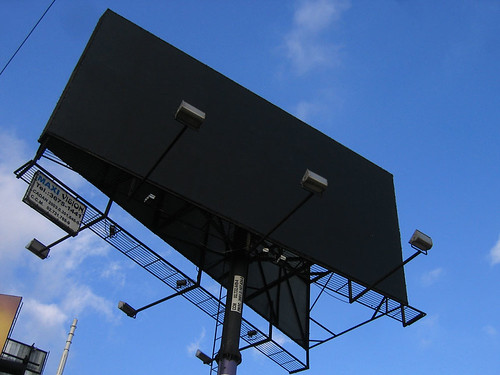
Tony de Marco’s photography does show one strange outcome of the law - the billboards and supporting structures still remain even thought he shrill call to BUY BUY BUY has been removed, leaving a ghostlike remembrance of the art of selling hanging over the city like some angels in a Herzog movie. I don’t know if this is the outcome I’d be after.
Going back to Raymond Williams, if communications is one with society, and if it could just as importantly be an alternative force “through which experience is described, shared, modified and preserved,” then surely there should be a case not simply for a comprehensive teardown of the billboards but of a shared space where society gets some of its mental space back. Imagine ‘folk advertising’ that shared recipes for jam, DIY tips or the very latest available on Freecycle; imagine a new platform for emboldened social marketing that promoted health, sustainability or tolerance; imagine simply setting these spaces over to art and creativity.
If communications is society’s shared conversation, and it has been all about consumerism until now, then let’s shift the topic, and talk about something new, and better.
Sunday, 31 January 2010
Communication responsables...

There's always a chance that some monolithic, multinational, boring, über-agency will stomp in and promise the world, but our network of creative, smaller agencies with a strong record on transport and the environment, has to be a winner.

We're thinking about formalising our network into something more high profile, structured around the notion of 'communication responsables', a French-born approach to sustainable communications which I'm busy learning about and which it would do no harm to bring to a wider audience in the UK. Core principles include transparency and honesty; it also appears to be a direct attempt to block ever higher levels of greenwash on the part of major corporates. More anon.
Thursday, 14 January 2010
Love your bike... just don't take a tram

Here's a good quote for a dark and frosty winter's day, it's from Arthur Conan Doyle:
“When the spirits are low, when the day appears dark, when work becomes monotonous, when hope hardly seems worth having, just mount a bicycle and go out for a spin down the road, without thought on anything but the ride you are taking.”
Lovely... but just don't try and get on a tram when those legs get a little tired, as it looks like Greater Manchester is about to vote to continue its ban on tram-borne bikes.
It pains me to say it, but when it comes to bikes on the metro, London can do it. In fact a host of other cities can manage it. Here's just a snapshot of light rail or tram services around the world that let cyclists on board:
Vienna
Sydney Light Rail
Brussels
British Colombia SkyLink
Calgary Transit
Prague
Copenhagen Metr
Lille – Transpole
Berlin BVG
Bielefeld moBiel
Frankfurt VGF
Hannover USTRA
Munchen MVV
Nurnberg VGN
Stuttgart SSB -
Amsterdam GVB
Rotterdam RET
Charlotte LYNX
Dallas Area Rapid Transit
Denver RTD
Miami Dade County Transit
Minneapolis MetroTransit
Phoenix Valley Metro
Portland Trimet
St Louis Metro
So there you go; not impossible; which was actually the conclusion of the Greater Manchester Authorities in 2002 when they “unanimously agreed to the principle of allowing bikes on trams during non-peak hours”.
Understandably, our friends at the Friends of the Earth-run Love Your Bike campaign are not best pleased. They think that allowing bicycles to travel on off-peak trams would encourage more people to combine tram and cycle journeys for commuting, shopping and leisure, and be an effective way to reduce carbon emissions. This argument is given greater power once they point out that Greater Manchester's own transport strategy suggests that between 2 and 5 miles is a perfect cycling distance, and that around 90% of the Greater Manchester population will soon be within a 2.5 mile cycle ride of a tram (when the hugely welcome new Metrolink services are completed).
The vote on this takes place tomorrow and Love Your Bike is calling on anyone who can to urge the GMITA committee members to honour the pledge made in 2002 and vote to allow cycle carriage on off-peak cycle trams. If you fancy adding your voice, click here to send them an email.
Friday, 22 May 2009
Benjamin on Klee

This storm is what we call progress.
Walter Benjamin,
Theses on the Philosophy of History
Subscribe to:
Posts (Atom)